Artificial Intelligence is everywhere in 2026—and yes, students are using it daily for assignments, research, and studying. But here’s the big question: where do you draw the line between smart use and cheating?
Look, I get it, university life is stressful but deadlines don’t wait, and the pressure to perform is real. AI feels like a lifeline. Still, using it the wrong way can seriously damage your academic record.
So in this guide, you’ll learn how to ethically use AI for university assignments without cheating, while improving your learning, protecting academic integrity, and maximizing student productivity.
Here is the real talk about using AI for your assignments: AI should support your thinking, not replace it.
What Does “Ethical AI Use” Actually Mean?
Ethical AI use means using tools like ChatGPT, Grammarly, Notion AI, and Perplexity AI in ways that:
- Respect academic integrity policies
- Avoid plagiarism or misrepresentation
- Enhance your understanding rather than replace it
- Maintain transparency where required
In simple terms: if you submit AI-generated work as your own without modification or acknowledgment, that’s cheating.
Why Ethical AI Use Matters More Than Ever in 2026
1. Universities Are Using AI Detection Tools
Institutions are increasingly equipped to identify AI-generated content patterns.
2. Academic Integrity Policies Are Evolving
Many universities now explicitly define acceptable and unacceptable AI usage.
3. Learning Outcomes Still Matter
If AI does all the work, your skills won’t develop—and that will hurt you long-term.
AI Tools Comparison for Ethical Academic Use
| Tool | Ethical Use Case | Key Benefit | Risk if Misused |
|---|---|---|---|
| ChatGPT | Idea generation, drafts | Saves time | Copy-paste plagiarism |
| Grammarly | Editing & clarity | Improves writing | Over-reliance |
| Notion AI | Note-taking & summaries | Better organization | Surface-level learning |
| Perplexity AI | Research & sources | Quick references | Inaccurate citations |
| Zotero | Citation management | Academic compliance | Minimal |
Step-by-Step: How to Ethically Use AI for University Assignments Without Cheating
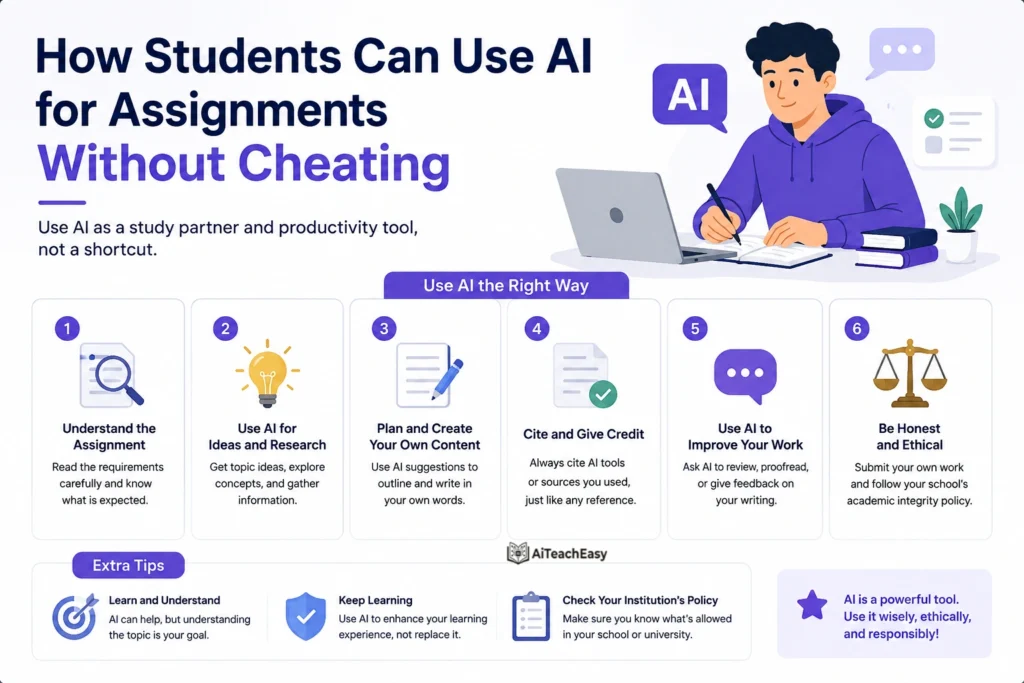
Step 1: Understand Your University’s AI Policy
Before using any AI tool:
- Check your course guidelines
- Ask your professor if unsure
- Look for rules on AI-generated content
Some universities allow AI for brainstorming but not for writing final drafts.
Step 2: Use AI for Brainstorming, Not Submission
Start your assignment with AI:
“Give me 5 ideas for an essay on climate change and economic policy.”
This helps you overcome writer’s block—but the final idea should be your own interpretation.
Step 3: Build Your Own Argument
Use AI to explore perspectives:
“What are the main arguments for and against this topic?”
Then:
- Combine ideas
- Add your own analysis
- Develop original insights
This is where real learning happens.
Step 4: Use AI for Literature Review Support
AI tools like Perplexity AI can help:
- Summarize research papers
- Identify key themes
- Suggest relevant sources
But always:
- Read original papers
- Verify accuracy
- Cite properly
Never rely on AI summaries alone for your literature review.
Step 5: Draft in Your Own Voice
You can ask AI:
“Help me outline this essay.”
But when writing:
- Use your own words
- Add personal understanding
- Include critical thinking
Otherwise, your writing may sound generic and lack depth.
Step 6: Edit and Improve with AI
Now bring in tools like Grammarly:
- Fix grammar
- Improve clarity
- Enhance readability
This is one of the safest and most accepted uses of AI.
Step 7: Cite Sources and Acknowledge AI If Required
Some universities require disclosure of AI use.
Example:
- “AI tools were used for brainstorming and outlining.”
Transparency helps maintain academic integrity and avoids penalties.
Step 8: Review for Originality
Before submitting:
- Run plagiarism checks
- Ensure originality
- Confirm all sources are cited
If something feels off, rewrite it. Don’t take risks—you might regret it later.
AI Ethics Checklist for Students
Before submitting your assignment, ask yourself:
- Did I use AI as a tool, not a shortcut?
- Is the final work written in my own voice?
- Have I verified all information?
- Did I properly cite sources?
- Am I following my university’s AI policy?
If yes, your on safe ground.
Pros and Cons of Using AI Ethically
Pros
- Saves time on research and planning
- Improves writing clarity
- Enhances understanding
- Boosts student productivity
Cons
- Requires discipline
- Easy to misuse
- Can reduce deep thinking if overused
- Policies may vary between institutions
Common Mistakes Students Make (And How to Avoid Them)
Mistake 1: Copy-Pasting AI Content
Solution: Always rewrite and personalize.
Mistake 2: Trusting AI Without Verification
Solution: Cross-check facts with academic sources.
Mistake 3: Over-Reliance on AI Tools
Solution: Use AI to assist, not replace your thinking proccess.
Advanced Tips for Ethical AI Use in 2026
1. Use AI for Smart Note-Taking
Tools like Notion AI help:
- Summarize lectures
- Organize notes
- Track ideas
This improves long-term learning.
2. Combine AI with Traditional Research
AI is fast—but academic databases are accurate.
Use both for:
- Better literature review
- Stronger arguments
- Deeper understanding
3. Ask AI to Challenge Your Work
Prompt:
“Critique this essay and highlight weak arguments.”
This improves critical thinking and strengthens your work.
4. Use AI for Time Management
AI can help you:
- Break assignments into tasks
- Create study schedules
- Track deadlines
This significantly improves student productivity.
The Future of Ethical AI in Education
AI is not going away—it’s becoming a core part of education.
Students who learn how to ethically use AI for university assignments without cheating will have a major advantage. Not because they rely on AI—but because they use it wisely.
And that’s exactly what platforms like lrnai.xyz are built for: helping students master AI without compromising their academic values.
Final Thoughts: Be Smart, Be Ethical
AI can either be your biggest academic advantage—or your biggest mistake.
The difference lies in how you use it.
If you focus on learning, thinking, and growing, AI becomes a powerful ally. But if you misuse it, the consequences can be serious.
So be intentional. Be responsible. And most importantly—keep your work authentic.
Call to Action
Start using AI ethically in your next assignment. Try brainstorming, structuring, and editing—but keep the final work yours.
Then explore more expert guides, tools, and strategies on lrnai.xyz to stay ahead in the future of learning.
And don’t forget—share your AI study hacks with your friends. Because smarter learning isn’t just about tools… it’s about mindset.
Leave a Reply