Look, I get it, university life is stressful but the real challenge isn’t just studying—it’s managing time. Between lectures, assignments, and deadlines, reading a 50-page research paper can feel overwhelming.
Now here’s the good news: in 2026, AI tools have completely changed how students handle academic reading. You no longer need to spend hours skimming dense material. You can summarize entire research papers in seconds—without losing key insights.
This guide will walk you through exactly how to summarize 50-page research papers using AI in seconds, while still maintaining academic integrity and improving your learning process.
If you’re serious about mastering AI for education, platforms like lrnai.xyz are becoming essential for modern students.
Why Summarizing Research Papers Matters More Than Ever
Before we jump into tools and steps, let’s talk reality.
Research papers are not written to be easy—they are written to be accurate. That means:
- Complex language
- Dense methodologies
- Long literature reviews
- Technical jargon
For students, this creates three major problems:
1. Time Drain
Reading one paper can take 2–4 hours. Multiply that by 10 papers for a literature review and your whole week is gone.
2. Cognitive Overload
You might read everything and still not understand the core argument.
3. Inefficient Note-Taking
Manual summaries often miss key findings or include unnecessary details.
This is where AI becomes your academic advantage.
What Does “Summarizing with AI” Actually Mean?
AI-powered summarization uses advanced natural language processing to:
- Extract key arguments
- Identify research objectives
- Highlight methodology
- Present conclusions clearly
In 2026, these tools are not just summarizers—they are academic assistants.
They can:
- Convert PDFs into structured summaries
- Generate bullet points for quick revision
- Simplify complex sections
- Help with literature review synthesis
Here is the real talk about using AI for your assignments: it’s not about cheating—it’s about working smarter.
Best AI Tools to Summarize Research Papers in 2026
Here’s a quick comparison of top tools students are using right now:
AI Tool Comparison Table
| Feature | ChatGPT | Perplexity AI | Scholar AI Tools |
|---|---|---|---|
| PDF Upload | Yes | Yes | Yes |
| Academic Focus | High | Medium | Very High |
| Citation Support | Moderate | Strong | Strong |
| Speed | Very Fast | Fast | Moderate |
| Best For | Deep summaries | Quick answers | Research-heavy tasks |
Each tool has its strengths, but the best results often come from combining them.
AI Tool Checklist for Students
Before choosing a tool, make sure it can:
- Handle large PDFs (50+ pages)
- Provide structured summaries (Abstract, Methods, Results)
- Maintain academic integrity
- Support note-taking or export options
- Work fast (seconds, not minutes)
If a tool doesn’t meet at least 3 of these, it’s probably not worth your time.
Step-by-Step: How to Summarize a 50-Page Research Paper Using AI
Now let’s break it down into a simple, practical proccess you can follow today.
Step 1: Upload the Research Paper
- Open your AI tool
- Upload the PDF (most tools allow drag-and-drop)
- Ensure the file is clear and readable
Tip: If the PDF is scanned, use OCR tools first for better results.
Step 2: Use a Smart Prompt
This is where most students mess up.
Instead of saying:
“Summarize this paper”
Use:
“Summarize this 50-page research paper into key sections: Abstract, Methodology, Results, and Conclusion. Keep it concise but academically accurate.”
Better prompts = better results.
Step 3: Generate a Structured Summary
The AI will usually return:
- Key research question
- Main arguments
- Methods used
- Findings
- Limitations
Read through it once to ensure accuracy.
Step 4: Ask Follow-Up Questions
This is where AI becomes powerful.
Ask things like:
- “Explain the methodology in simple terms”
- “What are the key limitations?”
- “How does this relate to my topic?”
This step transforms passive reading into active learning.
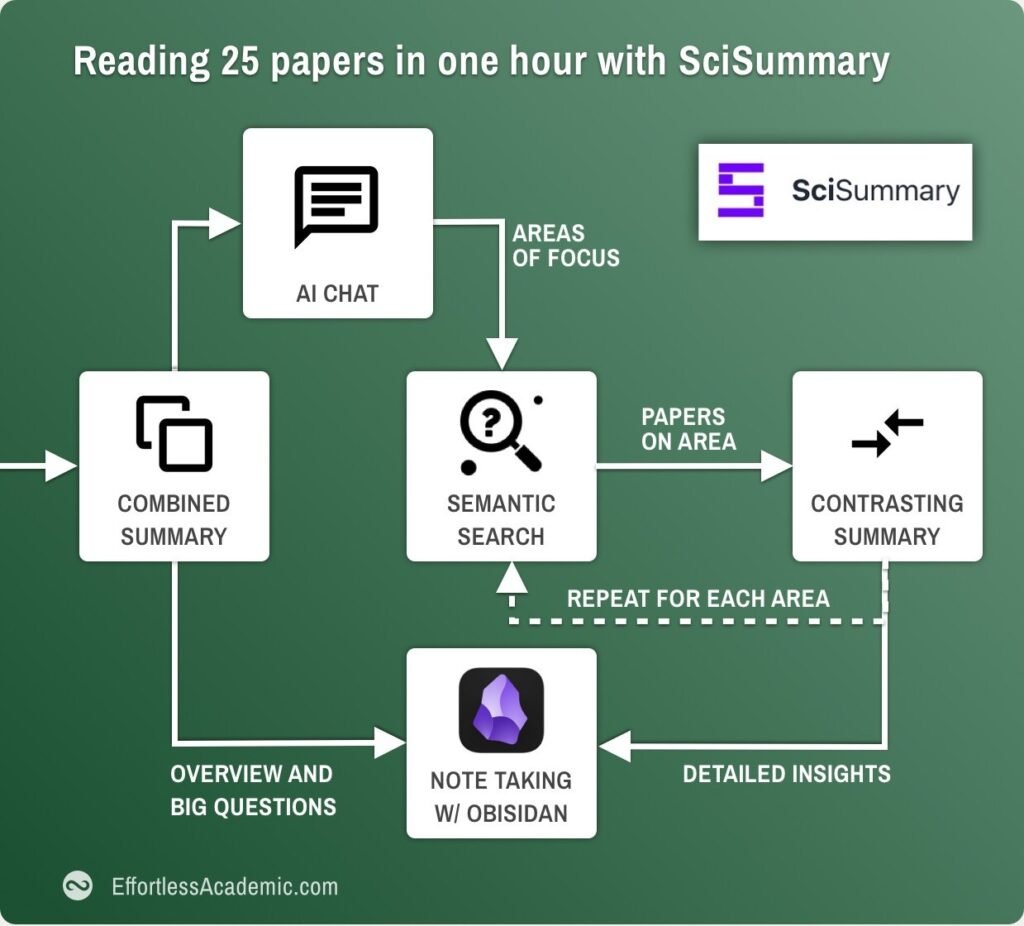
Step 5: Convert into Notes
Now turn the summary into:
- Bullet points
- Flashcards
- Mind maps
This improves retention and helps during exams.
Step 6: Cross-Check for Academic Integrity
AI is powerful—but not perfect.
Always:
- Verify key facts
- Check citations
- Read original sections if needed
Remember: AI assists you, it doesn’t replace critical thinking.
Advanced Techniques for Faster Summaries
Once you master the basics, try these strategies.
1. Chunking Method
Upload the paper in sections (e.g., 10 pages at a time) for more accurate summaries.
2. Comparative Summarization
Upload multiple papers and ask:
“Compare the findings of these studies”
Perfect for literature review work.
3. Simplification Mode
Ask AI to:
“Explain this paper like I’m a first-year student”
Great for difficult topics.
4. Highlight-Based Summarization
Some tools allow you to highlight text and generate summaries instantly.
This is a huge productivity boost.
Pros and Cons of Using AI for Research Summaries
Advantages
- Saves hours of reading time
- Improves student productivity
- Simplifies complex topics
- Helps with literature review writing
- Enhances note-taking
Limitations
- May miss nuanced arguments
- Risk of over-reliance
- Requires fact-checking
- Not always perfect with technical papers
So yeah, AI is powerful—but you still need your brain.
Ethical Use: Protecting Academic Integrity
Let’s address the elephant in the room.
Is using AI for summarizing cheating?
No—if used correctly.
Ethical use means:
- Using AI as a support tool
- Not submitting AI-generated content as your own
- Citing sources properly
- Understanding the material
Universities in 2026 are not banning AI—they are teaching students how to use it responsibly.
If you rely on AI without understanding the content, your not learning—you’re just copying.
How AI Helps in Literature Reviews
Summarizing papers is just the beginning.
AI can also:
- Identify research gaps
- Compare multiple studies
- Generate thematic summaries
- Organize references
For thesis students, this is a game changer.
Instead of spending weeks reading papers, you can analyze them in days.
Smart Note-Taking with AI
Modern AI tools integrate with note systems to:
- Auto-generate summaries
- Tag key concepts
- Create revision notes
This transforms how students study.
Imagine finishing 10 papers and having clean, structured notes ready instantly.
That’s not the future—it’s already here.
Common Mistakes Students Make
Let me be honest—most students don’t use AI properly.
Avoid these:
- Using vague prompts
- Blindly trusting summaries
- Skipping original content entirely
- Ignoring academic integrity
AI is a tool. If you misuse it, the results will show.
The Future of AI in Student Learning
By 2026, AI is no longer optional—it’s essential.
Students who learn how to:
- Summarize efficiently
- Take smart notes
- Conduct faster research
…will always stay ahead.
Websites like lrnai.xyz are helping students adapt to this shift by providing practical, real-world AI strategies.
And honestly, this is just the beginning.
Final Thoughts: Work Smarter, Not Harder
Summarizing 50-page research papers used to take hours. Now it takes seconds.
But here’s the key takeaway:
AI doesn’t replace effort—it amplifies it.
If you combine AI tools with critical thinking, you’ll:
- Save time
- Improve grades
- Reduce stress
- Actually understand your subjects
So next time you face a long research paper, don’t panic—use AI strategically.
Your future self will thank you.
Call to Action
Ready to upgrade your study game?
Start experimenting with AI summarization tools today and see how much time you can save. Then head over to lrnai.xyz to discover more powerful AI strategies, share your own study hacks, and stay ahead in the future of learning.
Because smart students don’t just study harder—they study smarter.
Leave a Reply